

Payroll is often thought of by Nigerian business owners as just paying salary at the end of each month. Beyond pay, however, companies have legal obligations that have a direct bearing on long-term business viability, reputation, and compliance.
The two most important responsibilities are pension contributions and pay-as-you-earn, or PAYE. Any expanding SME must comprehend them and manage them effectively.
Understanding PAYE in Nigeria
PAYE (Pay-As-You-Earn) is the personal income tax deducted from employees’ salaries and remitted to the appropriate State Internal Revenue Service. It is a tax on employee earnings, not business profits, but the responsibility for deducting and remitting it lies with the employer.
Under Nigeria’s tax system, tax coordination is overseen by the Nigerian Revenue Service (NRS).
Employer responsibilities for PAYE.
As an employer, your responsibilities include:
- Registering your business with the relevant tax authority
- Calculating employee taxes using approved tax tables
- Deducting the correct PAYE amounts monthly
- Remitting deductions on or before the 10th day of the following month
- Maintaining accurate payroll records
- Filing annual employer tax returns
Also note that, based on the new tax reforms, all employers and employees are now required to file their individual tax returns to their state IRS in addition to what their employers file as a company. This is for the purpose of including other income that is separate from salaries earned from your full time employer.
Many Small and Medium Enterprises (SMEs) struggle with under-deducting PAYE, delaying remittances, or using outdated tax computations. These mistakes can lead to financial penalties, interest charges, and in some cases, tax audits.
Poor PAYE compliance can also prevent employees and directors from obtaining their individual Tax Clearance Certificates (TCCs), which are often required for visa applications, loan processing, property transactions, government appointments, and other financial verifications. Consistent and accurate remittance ensures employees’ tax records remain clean and verifiable with the appropriate tax authority.
Pension Contributions: A Mandatory Employer Obligation
Nigeria operates a contributory pension scheme regulated by the National Pension Commission (PenCom). PenCom is the regulatory body responsible for supervising and ensuring compliance within Nigeria’s pension industry.
Under the Pension Reform Act, employers are required to contribute to their employees’ Retirement Savings Accounts (RSAs).
Contribution structure
- Employers must contribute a minimum of 10% of an employee’s monthly emoluments.
- Employees must contribute 8%.
- This makes a minimum combined contribution of 18%.
Monthly emoluments typically include basic salary, housing allowance, and transport allowance. However, pension compliance goes beyond deductions. Employers must:
- Ensure employees are registered with licensed Pension Fund Administrators (PFAs)
- Deduct employee contributions accurately
- Add the employer’s contribution
- Remit the total contribution within the stipulated timeframe after salary payment
Late remittances attract penalties, including interest on unpaid contributions. More importantly, non-compliance exposes the business to regulatory scrutiny and can weaken employee trust and confidence.
Why PAYE and Pension Compliance Matter for SMEs
Many small and growing businesses focus primarily on revenue generation while neglecting tax and payroll compliance structures. However, as businesses expand, regulatory visibility increases. What may seem like a minor payroll error today can become a major financial liability tomorrow.
Proper management of PAYE and pension contributions in Nigeria:
- Strengthens internal financial controls
- Improves transparency
- Enhances investor confidence
- Positions your business for partnerships and expansion
Structured payroll systems reduce compliance risks and ensure that statutory deductions become routine rather than reactive.
Building a Compliant Payroll Structure
Integrating PAYE and pension obligations into a well-designed payroll system is the most sustainable way to handle them. This entails performing regular compliance reviews, keeping abreast of regulatory developments, automating computations wherever feasible, and reconciling remittances on a monthly basis. Working with payroll and tax experts can help SMEs avoid expensive mistakes and free up management time to concentrate on expansion.
Ready to structure your payroll the right way?
Managing PAYE and pension contributions does not have to be overwhelming. With the right tools, you can automate calculations, maintain proper documentation, and stay compliant without second-guessing your numbers every month.
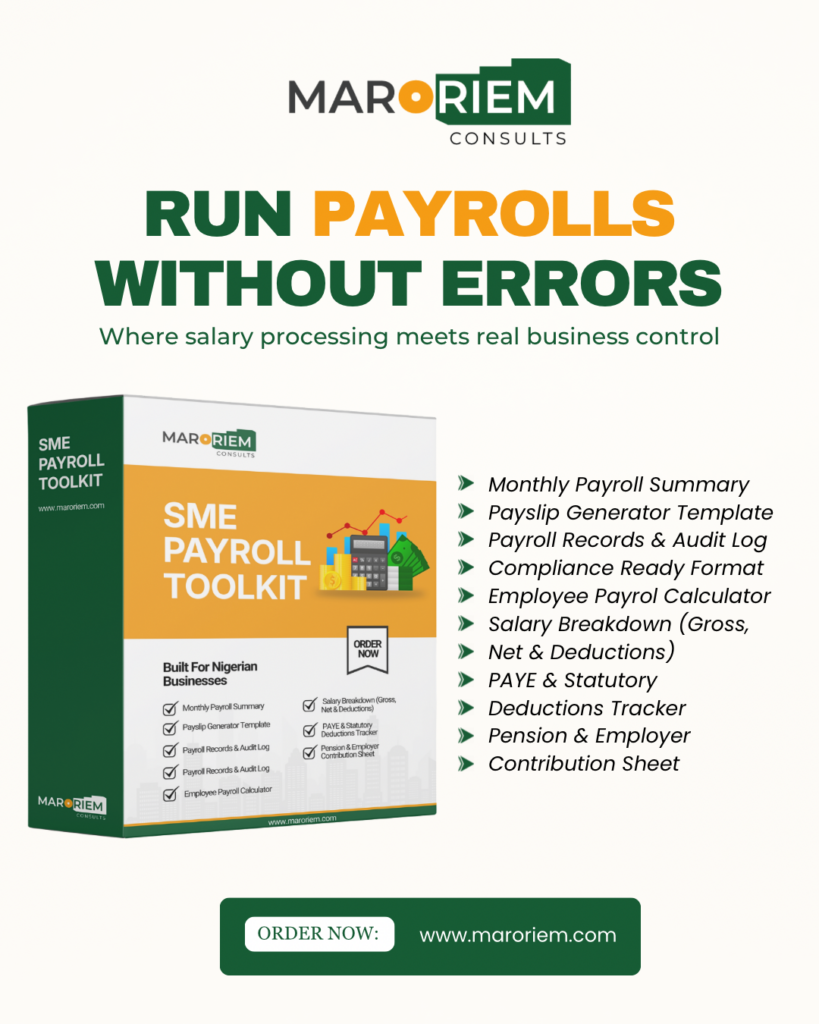
Maroriem Consults Payroll Template is designed specifically for Nigerian SMEs, built to help you calculate statutory deductions accurately, organize payroll records, and reduce compliance risks.
Get the Maroriem Consults Payroll Template today by visiting https://ernestmaroriem.com/product/sme-payroll-toolkit/ .Take control of your payroll process with confidence.